Tuesday, 2 October 2012

GREENBO re-visited!

You might remember earlier this year that I talked about a product that was new to the home garden design market. It's called Greenbo, and I'm pleased to announce I've just added Greenbo to my own balcony!


The distinctive 'G' in the trademarked Greenbo logo is a stylish and subtle addition to the product. Constructed in 100% weather resistant resin, the high grade Polypropolene material is light weight with increased strength and a range of 10 designer colours that will last for years. I'm the proud owner of a Greenbo 'planter' in black and plan on adding a couple of the GPR30 model smaller planters, possibly in the vibrant orange....although I love the turquoise....and the green....mmm....and the red!

Planting up is easy!  Firstly ensure the two removable drip trays are firmy attached to the base of the planter. Then start to fill the 2 chambers with a good quality potting mix containing water retention crystals and added slow release nutrients.


Don't overfill the chambers, about 15 litres of mix will be sufficient for the larger planter.

Once you've filled the chambers it's time to start planting up the Greenbo.  This is where you get to be creative. You could put in  a mix of succulents to create a low maintenance and low water garden. Or maybe a selection of potted colour for the season. But I had planned a herb garden for my Greenbo.


Now this is a bit of an experiment as I'm using only the one planter and I've decided to plant it up with a mix of both hard and soft leaf herbs. Ideally I'd plant them in different pots. It's always a good idea when planting any plants, herbs included, to place things together that have similar nutrient and watering requirements. Soft leaf herbs such as basil and parsley like a little more water than, say, sage or thyme; so you don't want to risk over-watering or under-watering and killing some of your plants!

What I've done is planted the soft leaf herbs in one side of the Greenbo; a mix of basil, parsley and coriander. In the other side I've planted the hard leaf herbs which are a mix of sage, thyme and oregano. And just for good measure I've planted some miniature orange marigolds which will are a natural bug repellant to help keep away the aphids and other pests.

Once planted up, the Greenbo is still quite light and easy to move into position. Of course you could always place it in position and do your planting 'in-situ'.


  The unique design of the Greenbo planter allows it to sit securely on railings, balustrades and fences up to 8.5cm in width. It will sit quite snugly on it's own but of course if you'd like to secure it this can easily be done with the instructions provided.


Once in place give your herbs a good drink of water mixed with a little bit of seaweed solution to help the roots settle in. Remember not to over-water as the drainage trays have a limited capacity.


And there you have it; a Greenbo herb garden! (and no, there is not a freeway running beneath the Greenbo...that's just trick photography!)

If you'd like to start your own 'Greenbo garden' you can find out more information at www.greenbo.com.au.

And you'll see Greenbo appearing in nurseries and garden centres around the city. Now's the perfect time to plant up your flowers for summer or get your own herb garden started and enjoy the fruits of your labour for months to come!


Thursday, 13 September 2012

Spring has sprung!

Well spring has certainly sprung in Sydney! The warm weather is wonderful although we have already had a taste of the extreme winds that hit Sydney throughout the warmer months. Now that the soil is warming up it's time to think about getting into the garden. 

Maybe you've thought about paving or decking a small area to create an outdoor dining space, or putting in a vegetable patch to grow your on herbs and veggies for summer salads. Whatever your plans, it's time to get started so you can enjoy the 'fruits' of your labour through summer!

This is also a great time of year to think of adding colour and shade to the garden. Many city gardens are 'compact' and owners believe they are too small for trees which might take over a garden. In fact, trees are a wonderful asset to any garden, and flowering trees can be quite spectacular; planted either as a single specimen or en-masse!

One of my favourite flowering medium trees for the suburban garden is the Largerstromia sp. or Crepe Myrtle. The 'Indian Summer' series are very pest resistant and produce beautiful sprays of flowers throughout the summer.


The colours range from pure white through pinks to vivid reds. Used throughout Sydney as a street tree, this is a testament to the fact that this tree is hardy and drought tolerant. It's the ideal tree to add summer colour to smaller Sydney gardens.

If your after flowers you can't go past blossoms! Cherry blossoms, apple blossoms, plum blossoms.....


  This spectacular white flowering cherry is Prunus 'Yoshino'. This tree will do well in the cooler areas such as the Blue Mountains and Southern Highlands. If your looking for something that will cope with the humidity of coastal Sydney then try Prunus cerasifera 'Nigra'. Growing to 5m high and 4m wide, this tree has incredible blackish-purple foliage and abundant pink flowers in late winter to spring.


Other trees ideal for the suburban Sydney garden are the Jacaranda with it's mauve flowers in October, the Illawarra Flame Tree (pictured below) with it's fire-engine red flowers sprays, the beautiful evergreen miniature Magnolia 'Little Gem' and even though they are a little expensive, the Corymbia hybrids 'Summer Pink' and 'Summer Beauty' are spectacular flowering miniature gums perfect for smaller gardens.


There are also many trees not specifically grown for their flowers that are ideal for the Sydney climate. Olea europaea the 'European Olive' is drought tolerant and relatively pest free. Betula sp. such as the White Birch looks great planted as a small grove, as does the medium sized Paperbark Tree, Melaleuca quinquenervia which is native to the eastern coastal regions of Australia. This species is identified by the the 'papery' sheaths of bark which give the tree great character.


There are hundreds of small to medium growing trees suitable for smaller Sydney gardens. Making the right choice is essential; how high with it grow? What is the width of the mature canopy? Is it deciduous or evergreen and how will this affect the amount of light coming into your garden at different times of the year? Is it suitable for a coastal climate or will it withstand the cold if your in the mountains or the highlands?

A good idea is to look at trees used in your street-scapes of growing well in your neighbours gardens, this will give you a good idea of what will work in your own garden!

So get down to your local garden centre or community nursery and see what trees are on offer. Pick out something that will add height and colour to your  garden. When planting remember to dig the hole twice the size of the pot the tree comes in. Add some compost to the hole as you back-fill and water in well, adding a seaweed tonic to help settle your new tree in. Make sure you keep the water up initially as the tree settles in, but it should soon be thriving on its own without any supplementary watering.

Go outside, enjoy the spring sunshine, and get gardening!
 

Monday, 13 August 2012

What a weekend in the garden can create!

Well it's great to see the sun finally shining in Sydney! After a few weeks of cold weather and the past few days of terrible winds and rain I was finally able to get outside and play in the garden!

This time last year I was helping a friend do a little light landscaping to get his garden in order for spring and ready for a summer of outdoor entertaining! Having recently built a large extension on the back of his home, the size of the garden was somewhat reduced. It's now only about 6m deep to the back fence, but almost 12m in width! What we needed is something stylish that hugs the back fence and will create a great back-drop without breaking the bank!!!

As the back fence was old, but in good condition it was retained. New fences are soon the be added up each side. To tie all the fences together we sprayed them with a Dulux Weathershield paint in 'Charcoal Essence'. This created our back-drop. 

We decided to make four panels out of small lengths of Merbau deck and use these as 'illuminated' panels. Outdoor halogen lights are fitted into the panels and light up the timber at night. 

For the centrepiece we made a stone encrusted panel. Using cement sheet and creating a framework, we applied a slurry of off-white cement then hand-placed black pebbles in a random pattern.


Using treated pine as the edging for the garden beds, we painted it the same a the fences to tie the whole project together. Using timber and pebbles in this way creates an interesting feature and is very cost effective. A light has also been placed in the ground in front of the pebble panel and will illuminate a pot or fountain...or maybe a pot that is a fountain!


In the corner of the garden there was a beautiful old Tibouchina lepidota 'Alstonville'.  This is a medium sized tree that was developed in Alstonville in northern New South Wales. It's a prefect specimen tree for smaller gardens and is covered in masses of beautiful purple blooms in autumn and right through winter. After flowering Tibouchina needs to be pruned to help produce flowers for the next season. This poor tree had been neglected for years (not by my friend....he only bought the property the year before...) and it had lots of dead wood and was quite straggly. I begged him to let me at it......nothing is better than taking to a tree with a branch saw and secateurs knowing that you will bring it back to life! Note the old fence on the right...almost ready to fall down!


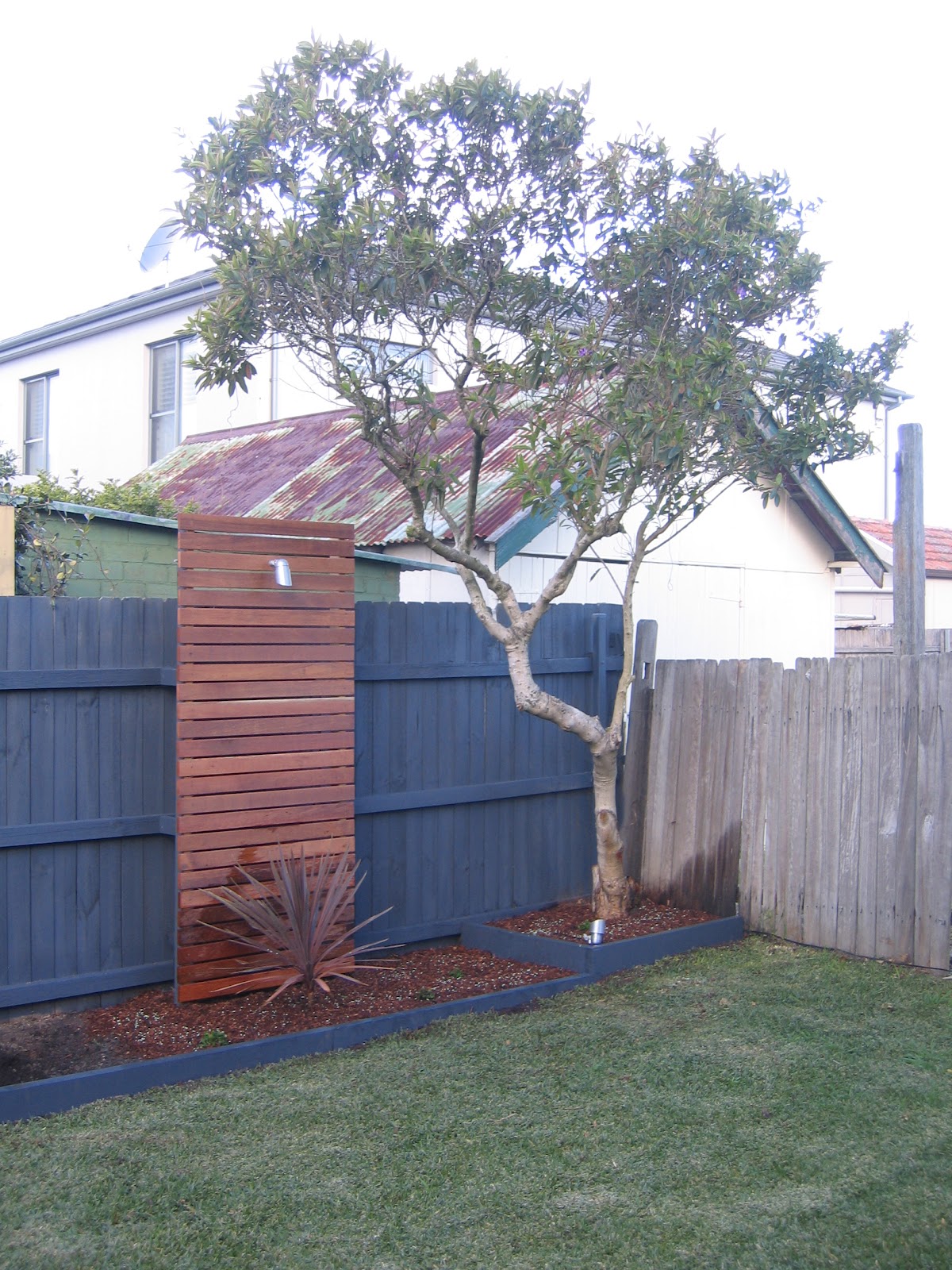
And here we are 12 months later....amazing what a difference a year makes in                                                              a garden!


The Tibouchina is in full bloom and looks a million dollars. This is not the best photo I'm afraid but you can see that the garden has been planted with Cordelyne sp. 'Red Sensation' in front of the timber panels and between the timber panels a couple of always elegant Magnolia grandiflora 'Little Gem', the evergreen Magnolia.

As you can see, a pot was chose as the centre-piece and is planted with a classic Cycad.

So with minimal materials and a little imagination you can transform a boring back fence into a garden in a couple of weekends! Go crazy with the paint spray gun, get creative with cement- slurry and pebbles or put your carpentry skills to the test creating timber panel screens.

    Get a couple of friends over to help you .....and get gardening!

Thursday, 12 July 2012

Something to ponder...........

"Some people look for a beautiful place.........


               .........others make a place beautiful"


                                 Hazrat  Inayat  Khan
                                            
                                      July 5, 1882 to Feb 5, 1927
                              Indian poet, musician and spiritual leader


Tuesday, 10 July 2012

A private courtyard in Sydney.

Following on from my last post about creating a 'Balinese' sanctuary in a suburban back yard, I thought I'd share a little project I did about 18 months ago. My friend lives in a lovely townhouse which is part of a residential complex in a popular and growing area of Sydney, close to the CBD. He's lucky enough to have a paved courtyard at the front of the property which faces north and is bathed in sunlight throughout most of the day. A cantilevered roof creates a wonderful covered area for seating which can be enjoyed all year round and in all weather.


The problem was that being in a rapidly growing residential area the issue of privacy was becoming a problem. Across the front of the courtyard large concrete pots planted with Strelitzia nicolai had become out of control, growing to almost 3m in height but breaking the pots with their dense roots in the process. While they created a bit of privacy, my friends wanted something more refined and orderly. What he wanted was a classic hedge.....but hedges are notoriously hard to grow to great effect in pots!!!


Also, as the residential complex is a 'strata' complex, any changes of a permanent nature such as building 'attached' structures require the consent of the Body Corporate Committee.  Mmmmmmm....how to get around this!!!


Easy! Create a structure that is essentially free-standing and non-permanent. A structure that looks like a masonry constructed planter-box but is in fact just a large 'pot' with no base and is not connected to any part of the building, merely sitting on the surface of the ground.


                          And here is what we came up with!!  


A planter-box that is clad with stone and looks extremely permanent. Now I'm not saying that I would like to have to remove it....but it could be dismantled and removed and leave no evidence that it was actually ever there!


The construction method and materials combine in a process I devised about 12 years ago when faced with the prospect of a huge brick-layers bill to have masonry planter-boxes constructed in my own garden.  I worked out a method of constructing the boxes so they are water resistant, then using an external covering that can be painted as it is, or clad in any number of materials; metal sheet, timber, or as we have used here....'stack-stone' tiles. It can also be 'rendered' using a texturing painted finish to give the effect of cement render.


Of course the structure has no built-in base. It sits on the paved area. So good drainage was essential. A 20cm base of crushed blue-metal was used to ensure water passed through easily. This was topped with a geo-textile membrane which is a fabric used in horticultural situations to allow water to pass through easily, but stop the movement of soil so that it doesn't wash away as the water passes through. But...a word of caution......never put a layer of sand on top of the geo-textile fabric...while it may help to 'filter' the water as it passes...it actually can become waterlogged and stop the passage of water and your garden bed will become a dead, soggy mess!


Drainage was already a feature in the paved area and any water that seeps from the planter drains to this collection point.


The garden was planted with Murraya paniculata, also known as 'Mock Orange'. It's quick growing, responds well to regular trimming to ensure bushiness and is relatively disease free and vey drought tolerant. It's quite an old-style plant is is regularly used for hedges ....but that's because it works so well. As a hedge it's kept neatly trimmed but if allowed to bush-out and flower, the lovely white blooms have the most beautiful smell of orange blossom; a heady scent on a summer night.


Now complete with a large wood table and bench seats for outdoor dining, the courtyard is a wonderful space to share a meal or bottle of wine with friends; and a relaxing sunny space to read the morning paper with a cafe latte! Just behind the table you can see a smaller version of the planter we created on the  side wall. This is planted with Ficus pumila which creates a living vertical sculpture as it clings to the wall. It's kept in check with regular trims by my friend so that it doesn't get out of control!


If your interested in finding out more about the construction technique of the planter-box, email me at  groundedgardens@hotmail.com and I'd be happy to share my methods.


So there you have it; another idea of what can be created in small spaces. If your handy with a few power tools and have a little imagination it's amazing what you can achieve! 

Thursday, 28 June 2012

Create your own Balinese paradise.


Last week I was writing from the sunny, balmy island of Bali. Today I'm home in Sydney and the rain is splashing against the window glass; the wind has died down a little...... but the heating in on high!  Brrrrrrrr


Wouldn't it be lovely to have a bit of Bali, or for that matter any paradise you dream about, in your own garden. Sometimes all it takes is a couple of statues or ornaments the remind you of a particular place, or specific plants to evoke feeling and memories of being on holiday....every day!


This is a garden I created about 10 years ago and it holds a very special place in my heart. It started with a rectangle of sand that didn't even have a blade of grass. The pool was put in, decking boardwalks were laid and garden beds planted with numerous palms and other 'tropical' plants.


At the rear of the garden a 'bale' style pavilion was created that easily converted to a daybed for lounging about on sunny afternoons. A tented canvas roof clipped in to provide shade but could be removed to let the sun shine in. Gauzy curtains could be easily clipped in to add an air of whimsey and create an outdoor room.


When planning a garden of a particular style it's essential to choose plants that evoke the feeling your looking for, however sometimes tropical plants don't always thrive in sub-tropical conditions. To create the upper story I planted Bangalo Palms, commonly known as  Archontophoenix cunninghamia.  These are tall growing, elegant palms that are 'self cleaning' which means the plam fronds will drop without having to be cut off. Another essential plant for a tropical-style garden is the Frangipani or Plumaria sp. The beautiful colours and fragrance of the flowers is pure 'holiday'!


You can also notice the statues and carvings that help to create the mood. The white stone is very typical of Bali and I had a wonderful time shopping in Batabulan in Bali; an area renowned for stone carving. I picked out a huge array of statues, bowles, stands, lanterns and wall plaques and had them all packed up and shipped home to Sydney.


It's these small decorative features that can really help to bring your garden design together. But you don't need to go to Bali to get the goods....although it is a good excuse for a quick getaway.... "honey....I have to go to Bali to buy some sculptures for the garden".....I'm sure that would go down well.

Another idea I incorporated into the garden was an outdoor shower. I thought it would be fun as outdoor showers are common in the tropics, and it could be useful to wash off the dirt and grime from working in the garden before plunging into the pool.


So no matter what your garden style is....or your favourite holiday destination, you can bring a little paradise to your own home. You could even set up your balcony with a daybed and some palms, have a frangipani in a pot, put some decking tiles down over those grotty old quarry tiles. Add a splash of colour with bright pots and incorporate a water-feature to blur the city noise.

Whatever you do, think outside the square and get gardening!

Thursday, 21 June 2012

grounded GARDENS: At Home in Bali.

grounded GARDENS: At Home in Bali.: groundedGARDENS is living the life of luxury this week in a beautiful private villa on the dream island of Bali in Indonesia. I'll keep th...

Thursday, 14 June 2012

At Home in Bali.

groundedGARDENS is living the life of luxury this week in a beautiful private villa on the dream island of Bali in Indonesia.


I'll keep the name of the villa a secret for fear of letting the cat out of the bag and never being able to secure a booking again!  Needless to say, staying in a private villa completely changes your holiday experience. In fact we have felt so relaxed and 'at home' that we have had a couple of days where we have simply relaxed by the pool, or slept in the shade of the bale and only ventured out for dinner in the evening.


From the moment you enter the carved antique gates you're immediately transported into another world, away from the dusty lanes, the honking taxis and stray dogs. Close the gates and lock away the outside world and your in a private sanctuary. This is a great idea for any home or garden; creating a unique entry point to draw the visitor in giving only a hint as to what exists behind the closed doors.


This elegant seating area is adjacent to the lounge area which can be closed off with bi-fold wood and glass doors for those times when you just need a bit of air-conditioning. Walls are clad in the pale local limestone; small niches hold buddha's which are subtly lit from above; and the built-in seating has a comfortable mattress and cushions creating a lovely place to read magazines or enjoy an evening drink. The black and white check fabric is a sacred design and can be seen wound around stone statues of temple guardians protecting the temples and homes of the Balinese.


Essential to any great home of garden design is good lighting. This might take the form of concealed spot lights in the garden to highlight tall, slender palm trees; or small spot lights to illuminate the face of a stone buddha or carved wall plaque.


Here the lighting over the outdoor dining area makes wonderful use of the local crafts; using woven cane fishing baskets that have been lined with an opaque white film to create gorgeous hanging lanterns. Using a dimmer switch these can be turned up to create a bright dining space, or turned down to softly illuminate the dark timber dining table and the faces of friends and family gathered for a meal for drink. And doesn't everyone look fantastic with their tanned skin glowing under moody, soft lighting.


After dinner it's out to the pool for a refreshing dip. I slip into the cool water and as I lay on back I gaze up at the stars to a night sky dotted with stars.


I feel absolutely blessed to be able to spend time in this wonderful paradise with my partner and great friends. Being in the villa is like being in our own home. The lovely staff are so welcoming and have been treating us like royalty. Plates of fresh fruit and strong Bali coffee help us get started, but it's usually 11am before we truly get started and head to the beach.

If you had the space you could create your own Balinese paradise in your own garden......soft lighting, statues and tropical plants....but you would need to have the climate to go with it!

Monday, 28 May 2012

West-Australian Wildflowers.

As promised, today I bring you an insight into the diverse and beautiful flora indigenous to the state of Western Australia. I'm in Perth, the capital of Western Australia and one of the world most isolated capital cities. The state covers an area that is roughly the same size as Spain, France and Germany combined! Known as one of the oldest land masses on Earth, the state is rich in minerals and is a great source of mining wealth (for a few very rich individuals...but lets not go there...); more importantly, it is rich in unique flora, many species of which are found nowhere else in the world.


When the rains of June and July soak the dusty, parched earth.....the rich red soils explode into a riot of vivid colours as wildflowers carpet the landscape lasting for up to 5 months through to December.


While there are many tour operators that offer the chance to see these rare beauties in their natural state, you can get a glimpse of these delicate blooms in the magnificent King's Park and Botanic Gardens in Perth.


Perched high above the city of Perth with views over the city and the Swan River, King's Park is an area of 400 hectares which showcases the spectacular flora of Western Australia. The area, located on Mount Eliza, was first gazetted a national park in October 1st 1872.


The colour and variety of wildflowers defies the imagination, there are between eight and twelve thousand varieties of wildflower in Western Australia and some 319 species are showcased in the park.


Perhaps one of the most unique specimens in the park, and one of my favourites is the Adansonia gregorii, more commonly known as the 'Boab' or 'Bottle Tree'. This is the only Boab tree endemic to Australia, although other baobabs are found in South Africa, Madagascar and the Arabian Peninsular.......interesting links to continental drift!


Easily recognised by it's swollen base which gives the tree a 'bottle-like' shape, this tree is indigenous to the Kimberly region of Western Australia. The tree can grow to between 9-12 meters with a trunk diameter of 5m.

The tree pictures above was moved due to a road widening project; it travelled the 3200km on the back of a truck, from the Kimberly's to King's Park, it's new home. 

The tree played a significant role in the traditions of the local Gija people of the Kimberly's who have now passes it on to the Nyoongar people, the traditional owners of the King's Park area.

Adansonia gregorii can live up to 200 years!

So if you ever find yourself in Perth, take a walk up the winding paths and steps to the summit of Mount Eliza and marvel in the breath-taking views over the city and the Swan River. Take a walk amongst the wildflowers and strange trees that make up a small part of a unique and beautiful part or the world........and get grounded!


Sunday, 27 May 2012

A BIG grounded GARDENS thank you!

I just want to say a HUGE thank you to all of you who have been having a peek at the grounded GARDENS bog!


In the past month my traffic audience has come from all over the world!!!  I've had visits from USA, Russia, Canada, Germany, Hungary, Latvia, Malaysia, Vietnam and Gabon!!  That's amazing and I'm so excited to think that people around the world are interested.


I'll be posting a new blog soon from the beautiful city of Perth in Western Australia....one of the worlds most isolated capital cities! 


And please feel free to send me a message at groundedgardens@yahoo.com.au or post a comment on the blog. You can post a comment as anonymous, but if you have a yahoo account post as yourself...and it's easy to create a yahoo account! I'd love to hear from viewers around the world and any ideas for things you'd like to see in the blog.


So once again...Thank you!  tell your friends about the grounded Gardens blog


                                And enjoy the space you live in! 

Friday, 18 May 2012

Is this really autumn?

 Those of us lucky enough to live in Sydney have just experienced our 25th day of blue skies and sunshine. It's been 25 days since we last had rain. If you find yourself a nice spot to sit in the sun, out of the cool breeze, you could be forgiven for thinking that we were experiencing a late summer!!! 


But alas, it is autumn and winter is fast approaching. Deciduous trees are loosing their leaves and most plants are going into a dormant state of no growth. It's at this time of year that gardens can look a little bare and colourless. Most gardeners will choose some bright and colourful annuals to spruce up the garden, and it's at this time of year that pansies and violas pop up; massed together in a riot of colour in garden beds and pots.


But what about bringing some of that colour inside? I have the perfect plant:


                                            Cyclamen  sp.


Cyclamen are a genus of plants containing 20 species that belong to the Primulaceae family. In the wild they are native to parts of Europe, western Asia and North Africa.


Cyclamens are the ideal indoor winter-flowering plant. In areas that experience a cold winter but where temperatures remain above freezing they can be used as a bedding plant in the same way we use petunias in summer. There are many hybrids of the principal species Cyclamen persicum and they grow from a fleshy tuber.


Ranging in colour from the purest white through pale pink, mauve and reds, cyclamens will last the entire winter if given a little tender loving care. And little care it what they like; don't overwater your cyclamen or they will rot away.....instead lightly mist the plant every few days and water with a light fertiliser solution once every 2 weeks. 


One thing cyclamen don't like is heat....so if you do have the air-conditioning or gas heating on make sure you pop you plant outside on the porch or balcony at night. The cool night air will keep your plant looking fresh and upright.


The petals of the Cyclamen are known as 'reflexed petals' because of the way they whorl away from the centre....almost as though they are caught in a fierce wind. 
     
If you've managed to keep your Cyclamen alive through the winter ...well done! Most people tend to over or under water and they only last a month or so. Never-the-less they are worth the effort. And unless you have a dry, cool place to leave them through the summer it's best to say goodbye...and pop them in the compost!


So forget about a buying bunch of expensive cut flowers that will only last a week and make the water in your vase go green, smelly and slimy. Go out and get a couple of lovely Cyclamen and be creative in the way you display them: wrap the plastic pots in coconut fibre and place them in clear glass vessels, or get a large bowl and put 3 small plants together in their pots for a mass display; fill in between the pots with sphagnum moss or small coloured stones. Or maybe just a single, regal plant in a plain white pot! Cyclamen will bring a burst of summer colour to brighten your winter days.


Sunday, 6 May 2012

The Nature of Design...and design in nature!

  Everywhere we look in nature we are greeted with a myriad of shapes, colours and images which inspire us all; from gardeners and chefs, to artists and designers.


While wandering through a roadside market in Mumbai, India I was struck by the natural beauty of the goods on display. It was not just the fruit and vegetables as items for sale, more the way they worked together to create an image or picture that would inspired the passer-bye to make a purchase, or just stop and look! This is visual merchandising at it's simplest!


As the old song says...."I've got a lovely bunch of coconuts".


Who would have thought that these stringy, strange looking drupes would have such visual appeal! This picture shows what is the mesocarp, or middle layers of the coconut and I love it's fibrous texture and blend of neutral colours. 


At the next stall a completely different image.                           
But once again a combination of colour and texture at has inspired artists and designers throughout the ages. 


The pineapple is an image that appears in 
paintings, fabric design and in home-wares....
Who doesn't love a pineapple-based table lamp?


Pineapples are actually the edible fruit of a Bromeliad, their botanical name is Ananas comosus
and it is not a single fruit, but a mass of coalesced berries, named for it's resemblance to a pine cone!


In the Philippines pineapple leaves are used to make a fabric called 'pina' and are also a component of wall-paper!


     Next, a bowl of dried chillies .....something to fire up the imagination!


And there we have it....colours, shapes and textures that appear in nature that inspire someone like me to stop...to smell, to touch and feel.......


So next time your wandering through the roadside market stalls of Mumbai,
.....or maybe it's the fruit and veg section of your local supermarket....


STOP    ...smell....touch....and feel....  and admire the incredible beauty of the simplest things we sometimes take for granted.


                         Nature;  the worlds greatest designer!  


Tuesday, 10 April 2012

Your own back-yard in the city!

Many of the greatest cities of the world have grown up around open spaces that were set aside as areas of peace and quiet by our clever pre-decessors. London has Hyde Park, New York has Central Park, there is Ueno Park in Tokyo...and Sydney has our very own and tranquil Centennial Park. Each of these parks provide a green oasis which is a welcome escape from the hustle and bustle of living in a busy city.

Opening in 1888 for Australia's centenary, Centennial Park is a part of what is more correctly known as Centennial Parklands, which includes Queens Park and Moore Park. Centennial Park sprang forth from uninviting swamp land and was laid out to be a grand Victorian park in the European tradition. Covering an area of 189 hectares, the park showcases spectacular seasonal garden beds, large specimen trees, and wooded groves.

  
An important feature of the park and one which helps to attract the many birds and animals that shelter in the area are the beautiful lakes and waterways. Although these waterways
have been made my man, the area
was originally known as 'Lachlan Swamps' and was the main water supply for the city of Sydney from 1837 to 1859.

Another key feature of the park are the beautiful specimen trees that dot the landscape. These include Norfolk Island Pines, Port jackson Figs and Holm Oaks.

(Left) The setting sun casts a beautiful silhouette through the branches of this Norfolk Island Pine. 


(Right)  This Port Jackson Fig will grow
to become one of the giants of the park and provide shade for generations of park-goes in the future.


The entire area of Centennial Parklands covers some 360 hectares and is home to more than 15,000 trees. A lovely feature to notice as you walk around the park is that many of the benches and trees have been donated by friends and family who have lost loved ones. Small plaques commemorate the lives now gone and are a lovely way to remember those not with us and to reflect in a tranquil and peaceful surrounding.

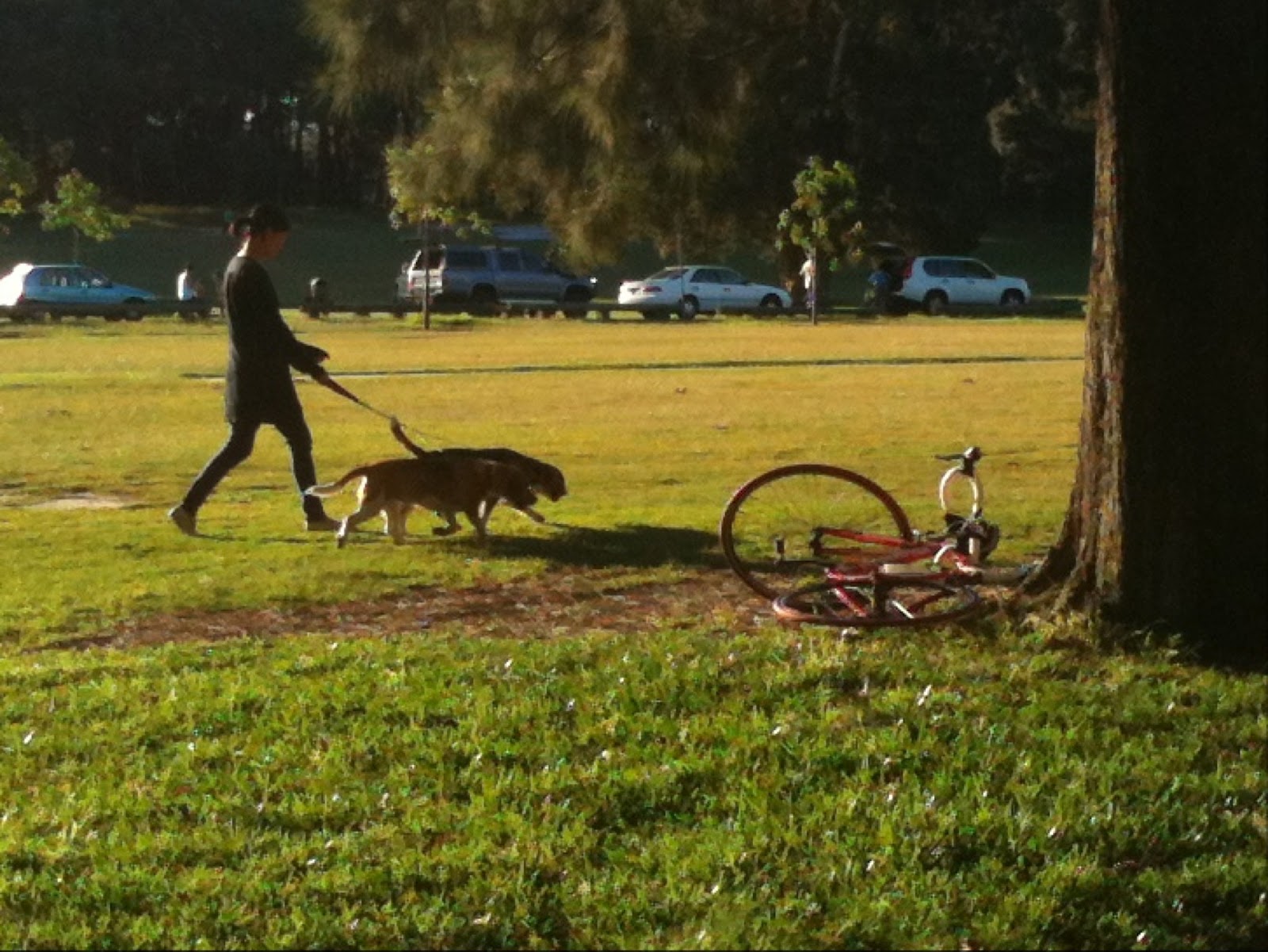
Today the park is enjoyed by hundreds of people every day from joggers and cyclists to roller-bladers and horse-riders and of course, those just wanting to relax with a picnic and enjoy the sun and serenity. 

 
So next time your travelling the world and you need a break from the hustle and bustle of the shops and crowds, head to one of the beautiful local parks or gardens and take some time out. Find a nice spot to sit and enjoy the sun, take in the view and feel the stress of city living fade away.

Public parks and gardens are for everyone to enjoy. Sometimes the garden your in doesn't have to be your own.....to get 'grounded'.