Thursday, 9 May 2013

You take the high road......I'm walking the High Line.

Continuing on from my last post, another 'must do' if your in New York City is a leisurely stroll along the fabulous 'High Line'.

The High Line is an historic elevated rail line that was used for much of the last century to carry freight above the streets of Manhattan's Lower West Side. When it was threatened with demolition in the late 1990's a group of local residents fought for it's preservation and founded the 'Friends of the High Line' who's ambition was to preserve and maintain this historic raised railway line and transform it into something new and entirely different. 


What they have created is a multi-purpose public space, a park that is unique in New York City. 

The walk starts (or finishes if walking from north to south) at Gansevoort Street in the lower Meatpacking District and is just a short walk from 14St subway station. I wasn't sure how long the walk would take so I got over here about 10am, grabbed a coffee.....tried to work out my east side from my west side (a compass would be great for walking in Manhattan) and set off! The picture above shows the Gansevoort St end of the High Line and it's a striking sight! I was pretty excited as I approached and you can just make out the stairs in the shadows under the structure that lead you up to the raised platform.

From my research I knew the High Line had been turned into a park and walkway but I really had no idea what to expect!


Immediately your confronted with a paved walkway that stretches off into the distance and on each side are the remnants of the High Line's past life. The rusted railway tracks and heavy wooden sleepers help to define the garden beds with shrubs and trees planted within.


Then as I looked forward to begin the walk, the path stretched off into the distance...and not just around building.....but right underneath them!

Unfortunately for me it was the beginning of April and the weather in New York was still particularly cold so spring was still in the air....and not in the gardens!

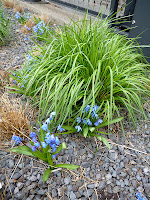
But as I walked along I could see the start of what was to come; small bulbs were still flowering, forcing their way up through the hard gravel garden bed to add a splash of red, yellow and blue to the otherwise grey landscape.
As you travel the High Line you get to gaze out over the streets of the Meatpacking District below and out over the busy port waters of the Hudson River to the west. 

One of the things I really loved about the High Line was the amazing use of timber and the ingenious construction of seating areas where people can sit and relax to read a book or take in the views.


Large banquette-type seating like this would be a great place to lounge and read a book or the paper, or to catch a few rays in the afternoon sun. And below, bench seating has been created where people can sit to watch movies and documentaries projected onto the wall opposite. This is a great use of space, and the park is not only a walkway but also a space for art exhibits, performance art and other public activities.


The High Line even incorporates it's own amphitheater where wanderers can sit and take in the view of Tenth Avenue stretching off into the north through Chelsea and on towards Hell's Kitchen!


A lot of the building that line the structure have been there for many years and the slightly decrepit and worn facades only add to the beauty and interest of the surroundings. Other building are used as giant canvases for works of art to advertise art gallery events and exhibitions....you certainly won't see a Coke sign painted on a wall here!


As the tracks curve and meander along the walkway you forget as you gaze at the buildings that border the High Line are the homes and offices of people who live and work with the constant parade of people looking in their windows. I'm sure this could be quite disconcerting, however one very clever resident got their own back on 'gawkers' with a very clever and strategically place art work.


It's almost as if he has said 'boo' as he caught you staring at him as he got out of the shower.....and you feel slightly guilty.....but only for a second as you realise the joke is on you!!  Very clever.


And before you know it you've strolled above 18 streets from Gansevoort Street to West 30th Street and come to the end of the line. A leisurely stroll that takes about 45 minutes with time to take photos and enjoy the view. 

During the spring the High Line is open from 7am to 10pm and there are a number of access points along the route, some with elevator access so the High Line is completely wheelchair accessible.


The third section of the High Line, pictured above, extends from West 30th to West 34th Streets and has yet to be completed. The 'Friends of the High Line' work with the New York City Parks and Recreation Department, and raise 90% of the funds needed annually to help preserve and maintain the park.

Check out their website at  www.thehighline.org

So if you happen to find yourself in Manhattan take a stroll above the streets and enjoy a bit of peace and tranquility in this truly unique 'park in the sky'. 


Friday, 19 April 2013

New York, New York! spring has sprung in the Big Apple!

Last month I was lucky enough to enjoy a trip to New York. I was especially lucky as I was in town for the annual Macy's spring Flower Show.


Macy's in New York is known as 'The World's Largest Department Store' and is located on 34th Street and Broadway in Manhattan. There are many stores throughout the US and every year they have a flower show to celebrate spring; however the New York stores display is the biggest and the best!


The window displays are incredible with a riot of colour and often have poems, stories or words of wisdom to accompany the floral displays.


These window displays are amazing and it's true to say that the 'art' of window dressing is something that is lost in Australia. If you go to England, Europe or the USA a huge amount of time and money is spent on creating window displays that not only showcase the wares of the purveyor but also the incredible talent of the artists who create the displays.


At Macy's, flower arrangements are located through the store with major displays located at entrance ways in and atrium areas, however the biggest and best is saved for the main display with is located in, of all things.....a tent!!!!

A large temperature controlled tent is located outside the main entrance to the store in Broadway. It was a balmy 20 degrees C inside while the wind chill outside was a chilly -2 C !!! This years display was styled with an 'Indian' (as in the sub-continent) theme. As you can imagine it was a mass of clashing and contrasting colours with a multitude of blooms of varying sizes and shapes.


A you enter the tent your greeted by the sight of a life-sized elephant adorned in flowers and Indian finery. The walls are decorated with pointed arches and columns reminiscent of an Indian temple. A ledge above the arches is filled trailing vines and flowers which creates a tranquil hanging garden. 


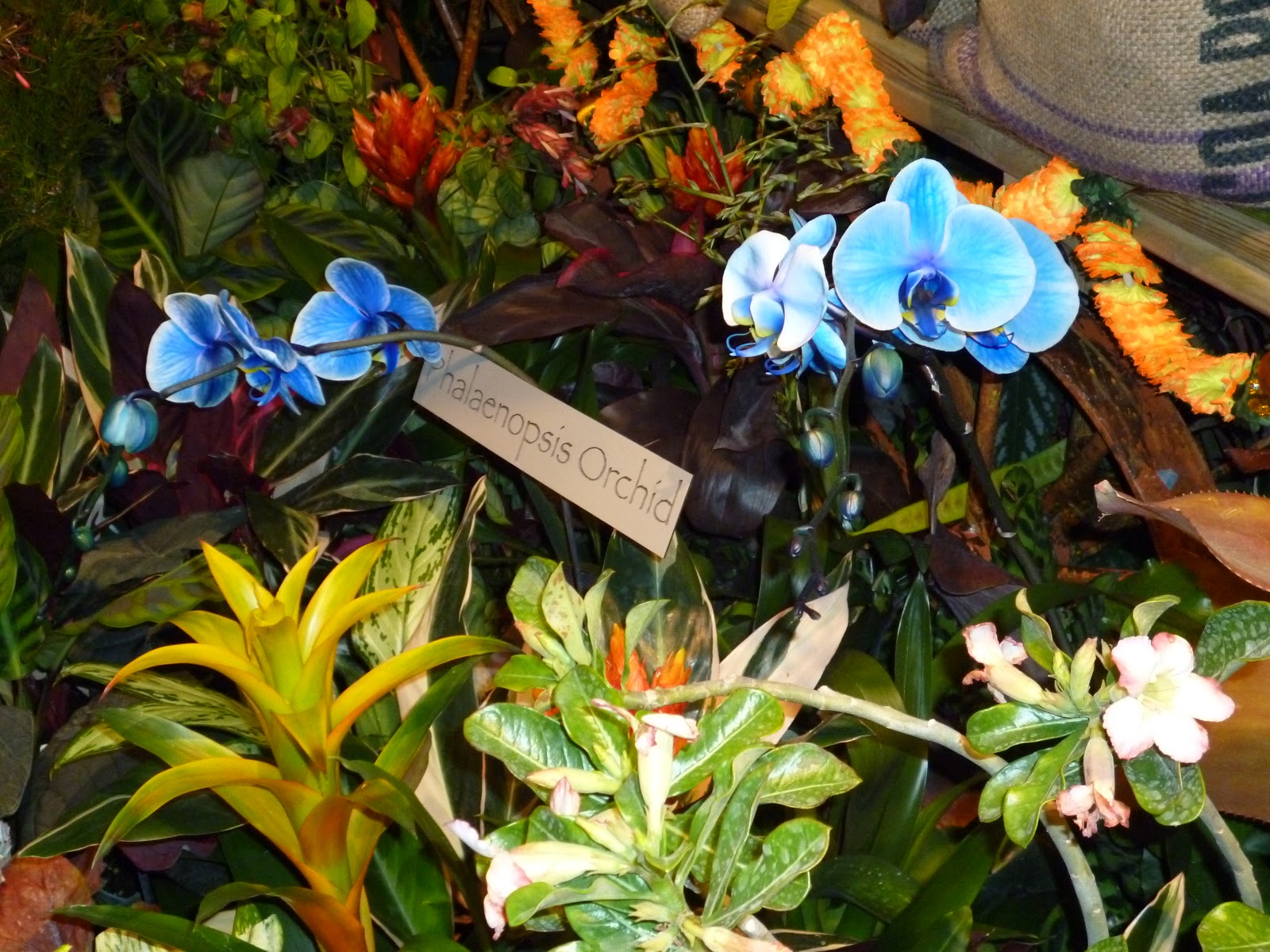
One of my all-time favourite plants and the one I've had the most success in killing is the beautiful Phalaenopsis Orchid also known as the 'Moth Orchid'. These plants bloom in a variety of colours from white through to dark reds and purples and can be solid in colour or spotted like the picture above.


And something I've never seen before was this incredible blue Phalaenopsis.


And below a mass of hot-pink hydrangea is surrounded by clivea which will bloom in bight orange, and delicate pale pink hellebores.


As you wander through the tent which is divided into a number of 'garden rooms' you come across the calming central fountain which is carved in white marble and surrounded by a mass of flowers such as tulips and begonias. I'm not sure what the blue flower is (can anyone help?) but it looks like a Cenatura or 'bachelor's button.


Passing through an arched wall, again topped with a garden of trailing flowers you enter what would be described as the spice market!                               


Bags of colourful spics compete with the flowers and add splashes of yellow, red and orange to the colour palate!


And just near the exit an array of pinks include azaleas surround a pink and green bormeliad. While below... red,cream and green striped Negoregelia bromeliads are surrounded by a mass of orange blooms of begonias, cliveas and gerberas.


And finally....a small thought....a message of peace and hope printed on the large window display pictured above with the peacock as it's centerpiece.


Time is a shifting perception.
Ancient symbol of immortality, the peacock,
preens amid the primrose, allegory of youth.
But look again. Those resplendent tail "feathers"
are concocted of palm, timeless sign of peace.
May there BE.


Tuesday, 26 February 2013

Herbalicious....

Even if your thumbs are more brown than green and you live in a city apartment with a balcony the size of a cupboard, you can still have the pleasure of growing your own herbs without too much fuss.

Herbs are really quite easy to grow and not only look great, they're useful in the kitchen as well. Herbs can also be planted as a green backdrop to flowering plants in a container or garden bed which makes them not only practical but beautiful as well.

One of the most useful and easiest to grow would have to be Parsley (Petroselinum crispum). It's bright green leaves may be added to a multitude of dishes and the stems are often used to flavour soups and casseroles. 

    
Pictured left is the common 'Curley-leafed Parsley'.


Another often used variety is the 'Italian' or 'Continental leaf' parsley which has a flatter leaf and more distinct taste making it very useful for cooking.


One of my favourite herbs to grow has the most amazing smell....it reminds of of summer. Basil or Ocimum basilicum, must have one of the most recognisable smells of all herbs!


What would Italian cooking be without basil? Basil is actually a part of the 'Mint' family Lamiacece and actually originates in India! Yes...India where it has been cultivated for over 5000 years!! And if you've been fortunate enough to travel through Southeast Asia I'm sure you'll have tasted the widely used 'holy basil' or Ocium tenuiflorum which is widely used in the cuisines of Thailand, Cambodia, Vietnam, Laos and Indonesia. 

Not only useful in cooking, basil has also been used for it's medicinal properties in Ayurveda, the traditional medicinal system in India.

Now, as a 'true blue' Aussie, who could go past a lamb roast??? And what's a lamb roast without two of our favourite herbs?? Mint and Rosemary.

The mint family is divided into 13 to 18 species. (this is not completely clear as there has been some hybridisation among the species and there are many cultivars) Mint is an extremely recognisable aromatic herb which is perennial, which means that it will last through the year and does not need to be replanted every season. Mint grows well in damp to moist soil and will spread through underground runners in the right condition. Ideally it should be grown in a pot or in a contained garden bed on it's own and kept quite moist.

  
Mint was originally used as  a medicinal herb and is still used today to treat stomach upsets. Mint is also thought to stimulate the mind!!! In ancient times it was strewn across the floor to mask the smells and odours of the day...as people walked over the mint they crushed the leaves, releasing its pleasant scent. Today it is the most predominant flavouring used in toothpaste due to it's refreshing and reviving taste.

Rosemary (Rosmarinus officianalis) is a woody perennial herb with fragrant, evergreen needle-like leaves. Funnily enough it is also a member of the 'Mint' family 'Lamiaceae' as are many other herbs. Rosemary is native to the Mediterranean region and is very drought tolerant and hardy in exposed windy and salty conditions. The forms of rosemary range from bushy and upright, to trailing ground-cover.


Being such a hardy but attractive herb, rosemary is used in many garden situations and is useful as a hedge. Depending on the species it will flower with white, pink mauve or blue blooms. Rosemary is traditionally used as a flavouring for lamb and casseroles; small branches of rosemary will impart flavour to food when it's burnt in a bbq or grill. 

Medicinally rosemary was used as a tonic to aid memory loss and is still used in Australia today, small sprigs of rosemary pinned to the lapel to honour and 'remember' those that fell in the great wars. Rosemary grows wild on the Gallipoli Peninsular.

Plant rosemary in a pot of well drained soil and water sparingly. Pinch it back regularly to encourage bushy new growth.


Other herbs that will grow well in containers and pots are Thyme (Thymus vulgaris), Oregano (Oreganum vulgare) and Tarragon (Artemisia dracunculuc) all of which will grow happily together in the same pot as they have similar growing conditions and requirements.


Even if your not the world's best gardener or an award winning chef, herbs are easy to grow and will bring colour and fragrance to a garden, balcony, terrace or even into your home.

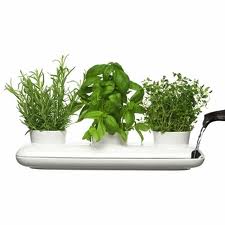
Get creative and pot a a miniature herb 'garden' such as the pictures above or plant up small individual herbs in smart modern pots as practical and personal gifts for family and friends. A 'herbalicious gift' is the perfect gift for that special someone who has everything!
 

Friday, 14 December 2012

The Perfect Gift for Christmas!

Well it's that time of year again; you've been running around doing all the Christmas shopping but there is always that someone that you have no idea what to buy.....that special someone that has absolutely everything!!!

If you've read some of my earlier posts you'll have seen the fabulous Greenbo!

I think this would make the ideal gift for Christmas. Made from 100% UV resistant polypropylene; it's tough and fade resistant making it the ideal planter for your balcony or terrace. Specifically designed to fit snugly onto a variety of railing shapes and sizes, the Greenbo XL Planter is your own mini-garden!!!


The Greenbo XL Planter comes in a range of colours such as Black, White, Red, Lime and Yellow. It's fits on railings from 5cm to 16cm wide.

I know I'd be very happy to find a Greenbo XL Planter under my Christmas tree on Christmas Day! And why not make it the complete gift and throw in a bag of potting mix and a selection of herbs for an organic herb garden! Perfect for the gardener that loves to cook!!!

You can fin more information on the Greenbo XL Planter at 
www.greenbo.com.au

From grounded GARDENS, all the best for the silly season, and get gardening!
  

Saturday, 1 December 2012

Transform a terrace: simplicity is the key!

Yesterday I was lucky enough to work on the outdoor terrace of an inner city apartment in one of the most beautiful locations in Sydney..... with possibly one of the most beautiful city views in the world! 


I was in Potts Point, doing a little transformation of the outdoor terrace of my friend Marie.

This apartment is in a block built about 25 years ago, replacing many of the old and crumbling terrace houses that once lined the street.  The apartment has a lovely and quite large outdoor space with folding glass doors, which when open invite the outdoors inside to the living and dining spaces. Marie had made the wonderful choice of covering the old 80's style terracotta tiles with lovely large squares of limestone. Unfortunately a selection of terracotta pots with agave and ficus still dotted the landscape!

 These pots dry out quickly in the exposed site and really didn't fit the size and scale of the terrace. Of major importance was to have a climber to grow up in front of the lattice panels which had to remain painted terracotta due to strata regulations.

I suggested we remove all the terracotta pots and find four large 'bang-for-your-money' pots that would work with the lattice panels and provide enough soil space to grow some climbers and other plants. Small pots will only allow so much growth and they actually require more care with watering and maintenance than larger pots. And the selection of light-weight pots available today makes choosing large scale pots a much easier option.


We found these wonderful 60cm x 60cm light-weight pots with a limestone finish. 

These pots are large enough to create a mini-garden within. My idea was to place 2 climbers towards the back of the pots and a clumping plant in the middle with some trailing colour in the front.


It's really important when using such large pots to think about weight. Not only for the weight on your balcony or terrace, but also if you ever have to move them!!! One trick I use helps to lighten them up and uses a waste product that would otherwise go into landfill. Polystyrene!!!!

It's fantastic; light weight, easy to break into pieces and will not break down. I put around a 15cm depth of polystyrene in these pots which will reduce the weight and provide excellent drainage. 


On top of the polystyrene I use a layer of geo-textile fabric which is designed specifically for use in the garden. It's completely water permeable, doesn't clog and will stop the soil on top from washing through the polystyrene and out the drainage holes of the pot.  Once your at this stage it's a simple matter of filling up with potting mix and planting!!!  But be warned....these 60x60 pots hold a whopping 6 bags of potting mix each....that's on top of the polystyrene layer!


Topped off with a mulch of 'Amazon Green' polished pebbles these mini-gardens look great!  The climbers we have used are Australian natives commonly known as the 'Wonga Vine', it's botanical name is Pandorea pandorana. This cultivar is called 'Snowbells' and will be covered in beautiful white bell-shaped flowers. In the middle we have planted a clump of Agapanthus praecox or the Blue Agapanthus. In front in each corner are Calibrachoa hybrid, you'll find these at your local nursery as 'Million Bells' and these have a beautiful cherry-pink flower. So we've kind of covered the colour spectrum with white, blue and pink against a backdrop of lush green foliage!


So there we have it, 4 not-so-small pots looking much cleaner and tidier and a little more 2013! I have to admit the size of the pots overwhelms the poor plants at this stage, and we could have used more mature plants but that would have increased the cost of the job immensely. Give these plants 3 months and they will be looking full and lush, and in a year or so the vines will be covering the lattice and blue agapanthus will be in bloom.....this will create a lovely back-drop for outdoor dining and even from the living and dining room throughout the year....

You could also install a drip watering system on a timer to take care of the watering for you....but I kind of think I'd be happy to stand out here with a Gin and Tonic and do the watering myself gazing over that amazing city vista!

So, for all of us in Sydney, 'happy summer'. And boy has it been a hot day to start the season!!!  If your out in the sun working or playing remember to cover up with a hat, sunscreen and sunnies, and drink plenty of fluids (water I mean, not G&T....well...not only G&T) and make the most of this fabulous time of year!

Friday, 26 October 2012

Newsflash: Purple Haze blankets Sydney!!!


It must be October! One of my favourite months of the year as Sydney is smothered in a haze of purple. The beautiful Jacaranda is in bloom! The Jacaranda is a genus of 49 species of flowering trees in the Bignoniaceae family which is native to the tropical and sub-tropical regions of South America.


In some areas of Sydney the streets are planted with avenues of Jacaranda which, when in bloom, form a magical canopy of mauve flowers which flutter to the ground like 'Purple Rain'...in the words of Prince!

It's quite adaptable and has been widely planted in many countries around the world for its beautiful colour and elegant shape. 

Of the 49 species, the one grown in Australia has the botanical name 'mimosifolia
refers specifically to the leaves which resemble the leaves of the Australian wattle
or 'mimosa' tree.


The leaves of the Jacaranda are long, up to 45cm in length and are 'bi-pinnately compound' which refers to the many leaflets that make up the compound leaf structure. The flowers can be up to 5cm long and are grouped into large 'panicles' which are essentially clumps of flowers which hang pendulously from the ends of the branches.

Jacaranda's will grown best in areas that are free of frost and one of the most spectacular plantings can be seen in the northern New South Wales town of Grafton which holds an annual 'Jacaranda Festival'.

One of the things I love most about the Jacaranda is the colourful carpet it's blooms create as they gently flutter to the ground. Although as beautiful as it looks I'm sure street cleaners think of the trees as a bit of a nightmare!  Still, beauty is sometimes a bit messy!


As I mentioned, the species we grow is the Jacaranda mimosifolia which will range from 5m to 15m in height and the canopy can spread up to 10m. So you will need to have a bit of space if your planning to have one in your garden. But they are definitely worth it for the colour the provide.....even if only for a couple of months of the year. And remember not to prune your Jacaranda; pruning causes the growth of 'water-shoots'...ugly growth that shoots straight up into the air like fishing poles which ruins the elegant, twisting, natural shape of the tree.

And if you do have the space, I'd recommend you plant a Jacaranda with the wonderful Australian native Brachychiton acerifolius, better know as the Illawarra Flame Tree. This tree, also used for street planting in many areas of Sydney produces a stunning display of bright red, bell-shaped flowers in late spring. Like the Jacaranda, the flowering is more spectacular when the winter months have been dry. 


     The colour combination of bright red and mauve is spectacular, and the fact that these two trees only bloom for 2 months at the same time of the year make them perfect planting companions!


So if your wandering about Sydney on a beautiful October blue-sky day and come across a carpet of purple-mauve flowers, look up and enjoy the Jacaranda canopy above you....it will all disappear before Christmas!


Tuesday, 2 October 2012

GREENBO re-visited!

You might remember earlier this year that I talked about a product that was new to the home garden design market. It's called Greenbo, and I'm pleased to announce I've just added Greenbo to my own balcony!


The distinctive 'G' in the trademarked Greenbo logo is a stylish and subtle addition to the product. Constructed in 100% weather resistant resin, the high grade Polypropolene material is light weight with increased strength and a range of 10 designer colours that will last for years. I'm the proud owner of a Greenbo 'planter' in black and plan on adding a couple of the GPR30 model smaller planters, possibly in the vibrant orange....although I love the turquoise....and the green....mmm....and the red!

Planting up is easy!  Firstly ensure the two removable drip trays are firmy attached to the base of the planter. Then start to fill the 2 chambers with a good quality potting mix containing water retention crystals and added slow release nutrients.


Don't overfill the chambers, about 15 litres of mix will be sufficient for the larger planter.

Once you've filled the chambers it's time to start planting up the Greenbo.  This is where you get to be creative. You could put in  a mix of succulents to create a low maintenance and low water garden. Or maybe a selection of potted colour for the season. But I had planned a herb garden for my Greenbo.


Now this is a bit of an experiment as I'm using only the one planter and I've decided to plant it up with a mix of both hard and soft leaf herbs. Ideally I'd plant them in different pots. It's always a good idea when planting any plants, herbs included, to place things together that have similar nutrient and watering requirements. Soft leaf herbs such as basil and parsley like a little more water than, say, sage or thyme; so you don't want to risk over-watering or under-watering and killing some of your plants!

What I've done is planted the soft leaf herbs in one side of the Greenbo; a mix of basil, parsley and coriander. In the other side I've planted the hard leaf herbs which are a mix of sage, thyme and oregano. And just for good measure I've planted some miniature orange marigolds which will are a natural bug repellant to help keep away the aphids and other pests.

Once planted up, the Greenbo is still quite light and easy to move into position. Of course you could always place it in position and do your planting 'in-situ'.


  The unique design of the Greenbo planter allows it to sit securely on railings, balustrades and fences up to 8.5cm in width. It will sit quite snugly on it's own but of course if you'd like to secure it this can easily be done with the instructions provided.


Once in place give your herbs a good drink of water mixed with a little bit of seaweed solution to help the roots settle in. Remember not to over-water as the drainage trays have a limited capacity.


And there you have it; a Greenbo herb garden! (and no, there is not a freeway running beneath the Greenbo...that's just trick photography!)

If you'd like to start your own 'Greenbo garden' you can find out more information at www.greenbo.com.au.

And you'll see Greenbo appearing in nurseries and garden centres around the city. Now's the perfect time to plant up your flowers for summer or get your own herb garden started and enjoy the fruits of your labour for months to come!


Thursday, 13 September 2012

Spring has sprung!

Well spring has certainly sprung in Sydney! The warm weather is wonderful although we have already had a taste of the extreme winds that hit Sydney throughout the warmer months. Now that the soil is warming up it's time to think about getting into the garden. 

Maybe you've thought about paving or decking a small area to create an outdoor dining space, or putting in a vegetable patch to grow your on herbs and veggies for summer salads. Whatever your plans, it's time to get started so you can enjoy the 'fruits' of your labour through summer!

This is also a great time of year to think of adding colour and shade to the garden. Many city gardens are 'compact' and owners believe they are too small for trees which might take over a garden. In fact, trees are a wonderful asset to any garden, and flowering trees can be quite spectacular; planted either as a single specimen or en-masse!

One of my favourite flowering medium trees for the suburban garden is the Largerstromia sp. or Crepe Myrtle. The 'Indian Summer' series are very pest resistant and produce beautiful sprays of flowers throughout the summer.


The colours range from pure white through pinks to vivid reds. Used throughout Sydney as a street tree, this is a testament to the fact that this tree is hardy and drought tolerant. It's the ideal tree to add summer colour to smaller Sydney gardens.

If your after flowers you can't go past blossoms! Cherry blossoms, apple blossoms, plum blossoms.....


  This spectacular white flowering cherry is Prunus 'Yoshino'. This tree will do well in the cooler areas such as the Blue Mountains and Southern Highlands. If your looking for something that will cope with the humidity of coastal Sydney then try Prunus cerasifera 'Nigra'. Growing to 5m high and 4m wide, this tree has incredible blackish-purple foliage and abundant pink flowers in late winter to spring.


Other trees ideal for the suburban Sydney garden are the Jacaranda with it's mauve flowers in October, the Illawarra Flame Tree (pictured below) with it's fire-engine red flowers sprays, the beautiful evergreen miniature Magnolia 'Little Gem' and even though they are a little expensive, the Corymbia hybrids 'Summer Pink' and 'Summer Beauty' are spectacular flowering miniature gums perfect for smaller gardens.


There are also many trees not specifically grown for their flowers that are ideal for the Sydney climate. Olea europaea the 'European Olive' is drought tolerant and relatively pest free. Betula sp. such as the White Birch looks great planted as a small grove, as does the medium sized Paperbark Tree, Melaleuca quinquenervia which is native to the eastern coastal regions of Australia. This species is identified by the the 'papery' sheaths of bark which give the tree great character.


There are hundreds of small to medium growing trees suitable for smaller Sydney gardens. Making the right choice is essential; how high with it grow? What is the width of the mature canopy? Is it deciduous or evergreen and how will this affect the amount of light coming into your garden at different times of the year? Is it suitable for a coastal climate or will it withstand the cold if your in the mountains or the highlands?

A good idea is to look at trees used in your street-scapes of growing well in your neighbours gardens, this will give you a good idea of what will work in your own garden!

So get down to your local garden centre or community nursery and see what trees are on offer. Pick out something that will add height and colour to your  garden. When planting remember to dig the hole twice the size of the pot the tree comes in. Add some compost to the hole as you back-fill and water in well, adding a seaweed tonic to help settle your new tree in. Make sure you keep the water up initially as the tree settles in, but it should soon be thriving on its own without any supplementary watering.

Go outside, enjoy the spring sunshine, and get gardening!