Saturday, 7 September 2013

Sensation Spring in Sydney! The Australian Garden Show

Well it looks as though I've just got home in time! The temperature has dropped and the clouds are rolling in on what was the most spectacular spring day in Sydney!

Today we decided to ride our bikes to the Australian Garden Show which was held in the beautiful Centennial Parklands in Sydney. I'm glad we decided to ride our bikes as the traffic was crazy...election day, Randwick horse races and the garden show all vying for space on the roads!

We couldn't have asked for a better day with the clear blue sky and temperature getting up to 31 degrees! After parking the bikes we troddled off to see what was on offer!


This is the inaugural Australian Garden Show and I have to say it seemed to bring Sydney-siders out in their thousands!! I think the great weather also had something to do with it too. The event is a showcase of well-known and up and coming Landscape Architects and designers, with garden displays, floral exhibitions, and a number of lectures and talks ranging from sustainable living to making your own organic fertilizer. It seems that 'vertical gardens' are the thing of the moment and I have to say they are very effective, having just installed one in our living room last month (but that's another blog.....) and there were plenty of examples to start you thinking .There are also cooking demonstrations in the Lindeman's Open Garden (where you can try their Early Harvest range of low alcohol wines) and plenty of areas where the kids can get down and dirty potting up their own creations or cuddling the cute little chicks...we even saw some hatching from their eggs!!!   ......but I digress.....

There were some big name Australian Landscape Designers who had created wonderful outdoor spaces. One of my favourites was Brendan Moar's 'Suspended' which was created for the Nursery garden Industry NSW & ACT.
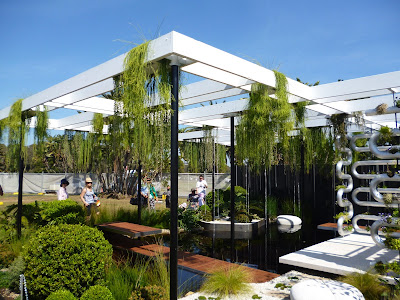

Many of the gardens followed the theme of 'the outdoor room' which has been a Sydney favourite idea for urban landscape design. A central pond is over-hung by lush planting and surrounded by an entertaining platform. The whole area is covered by an open, pergola-like structure. From this structure hanging plants cascade down almost as if they are suspended in mid air. Ingeniously Brendan has designed small 'platforms' within the framework of the pergola and the plants are sitting within these in pots!


In this way the pots can be easily removed, moved about or replaced to create different effects.


Another garden I enjoyed was Jim Fogarty's 'The Last Leave' which was a garden commemorating Gallipoli 1915-2015. It's a metaphorical interpretation of the trenches of war brought into the 21st century as a beautiful landscape...not the terrifying landscape of war.


The shelter at the back is symbolic of a trench or dugout, stone edging is an echo of the sandbags used to protect our soldiers. Rusted barbed-wire balls are the only remnants of the wire surrounding the trenches. 100 years on this place of war has been re-energised and re-visioned as a place of beauty and reflection. The plants will flower, seed, and re-grow; signifying the cycle of life and perpetuity.

Myles Baldwin created a lovely display entitled 'Sydney Gardenesque' which show-cases the beautiful golden sandstone upon which most of Sydney is built. The garden contains an eclectic mix of sub-tropical and warm temperate plants which were favourites of the Victorians in the mid-1800's. 


The pergola is simple in design and the white-framed structure is highlighted by the branches which form the roof, allowing fine shafts of light to filter through.

  In the garden was this beautiful native Iris with the most amazing large pure white flowers....I need to try to find out more about this plant!


There was also a small display of 6 urban gardens designed by up-and-coming landscape artists. I particularly like Kate Burgess's

 'The Hive'.


This garden draws on permaculture theory where all plants are either edible or functional in some way. I love the honey-combed screens that surround the central pavilion.


 It reminds me of a bee hive and the curtained pergola with it's seating area is the perfect place for the 'Queen bee' to relax and take her afternoon tea.....scones with honey perhaps!!!


A high-light of the day was meeting the lovely Indira Naidoo, tv personality and gardener; author of the new book 'The Edible Balcony'.


Indira's philosophy is that of groundedGARDENS...that you can make the most of the smallest area to create a beautiful, functional space. Indira created a stunning display of vegetables and herbs on her 20m square balcony and her book contains not only tips and ideas of how to use your urban space to create a productive garden, but inspiring and easy to prepare recipes for your home-grown fresh produce!

Needless to say I came home with not only Indira's book, but also some new secateurs, branch loppers and some lovely little pruning shears to keep our vertical garden in check (my partner is very happy I won't be using his scissors for this purpose...). I also got some little succulent rooted cuttings for 2$ a piece that have already been planted into my 'succulent bowl' to spruce it up for summer.

If you get a chance head to Centennial Park in Sydney tomorrow, it's the last day of the show. But it will be back next year so don't despair.  

With spring well and truly here and summer fast approaching, there is no excuse not to get your hands into some potting mix. Grab some herbs or flowering annuals...or some succulents or veggie seedlings and get gardening!

As Indira says......'Get dirty with me in the garden!' 

Friday, 12 July 2013

News Flash: Garden wall takes over building in Perth!!!!

My last post was about the creation of vertical gardens, or 'garden walls' as they are also know!

Just a quick report as a friend posted these pictures on Facebook today and I thought they illustrated one of the suggestions I made in the last post.


Not the clearest photo but it shows a cafe entirely enclosed in a wall of gardens! It uses the idea that I mentioned was also used in the 'Kitchen by Mike' restaurant in Rosebery; metal reinforcement grids enclosing terracotta pots.


This is a really effective use of easy to obtain materials and just goes to show that you don't have to spend a huge amount of money on fancy gardening to get a designer look!


This cafe is on St Georges Terrace in Perth and I don't know the name but I'm heading to Perth on Sunday so I'll try and find it and have a closer inspection.
(thank you Towie for these great pics....If I find the name I'll let you know!)

                                              Happy gardening!

Tuesday, 2 July 2013

The only way is UP.....garden design soars to new heights!

Another glorious day of sunshine in beautiful Sydney (recently rated the third most expensive city in the world to live in.....). I'm sure with all the cold weather and torrential rain of the past two weeks many of us would gladly have given up Sydney for warmer pastures!

But the sun is shining and it's nice to be able to get outside in the garden or out on the balcony and see how everything has stood up to the wind, cold weather and rain!!!  And I have to say....everything looks surprisingly healthy! It's lovely to be able to have a few pots for some colour and greenery when you live in an apartment; but imagine if you could have an entire wall filled with garden that flourished year round and wasn't affected by the weather. The perfect solution for indoors or out; a 'vertical garden'.

A vertical garden is just that; a garden that uses a vertical surface for planting. It makes a wonderful use of space in a beautiful and unexpected way.


In a vertical garden a combination of plants are used add colour, pattern and texture to what is essentially a flat vertical surface. Plants are chosen for their variations in foliage texture and colour, the size of their leaves and the way the might hang or drape, to create a living tapestry; a living work of art!


The pictures above show how effective garden walls can be in both exterior and interior applications. On the top, diagonal bands of foliage decorate the walls of a courtyard surrounding a swimming pool. Below, a sleek modern interior is accentuated by a living sculpture of green which is cleverly back-lit, making this a focal point in the room.

French botanist Patrick Blanc popularised his modern ideas and versions of green walls or 'Le Mur Végétal' in the 1980's. Check out his website at www.verticalgardenpatrickblanc.com for interesting facts and pictures of this botanic artists works.  It's interesting to note that the first concept of the vertical garden was suggested by a Professor Stanley Hart White at the University of Illinois in 1938, who patented the first vertical garden as 'Vegetation-Bearing Architectonic Structure and System'. However, it was Patrick Blanc who revolutionised the idea, integrating it's use into modern design and architecture.

The idea has been used internally to create a calm and reflective environment where people can relax and be pampered, such as the 'spa' zone in the Qantas First Class Lounge at Sydney international Airport, pictured below.


Quite often used externally as a feature to soften a wall, the concept has grown to cover entire buildings! The Central Park complex under construction in Sydney's Chippendale is a collaboration between Patrick Blanc and Paris architects Ateliers Jean Nouvel. This complex will be a dramatic masterpiece, a living tapestry that will change colour with the seasons and be covered in an exotic skin of buds, flowers, leaves and vines that will soar 150m into the air, transforming the Sydney skyline.


To see more images of this ground-breaking development and read about the design and concepts of the vertical gardens go to www.centralparksydney.com

The concept has also been used to great affect in Singapore's Changi Airport, below


the Icon Hotel in Hong Kong and the Sofitel Palm Jumeirah in Dubai, below.


If you'd like to create a vertical garden of your own there are many ways to go about it. A google search will bring up a variety of images and information about the types of kits available so that you can create your own green wall. 'Gro-Wall Vertical Garden Systems' is a product that is available in Australia There is even a system called the 'Wooley Pocket' which allows you to add pockets to create a green wall. The pockets are made out of recycled plastic bottles and are basically a pouch that is filled soil or a compost to hold moisture and act as an anchor for the roots of your chosen plants. You could also try making your own pockets using geo-textile fabric or even shade-cloth sewn into pockets with heavy duty nylon twine. Using this method you could create as many or few pockets as you like and tailor the size to fit your area.

I've even see a wall created using 2 sheets of steel reinforcing wire sandwiched around terracotta pots. This is used to great affect in the 'Kitchen by Mike' restaurant in Sydney's Rosebery. 


While not exactly a 'green wall' this is certainly a vertical garden and would be a fantastic use of space on a balcony or terrace.....plant the pots up with a variety of herbs and creative a vertical 'kitchen' garden! 

So now that the sun is shining again in Sydney there is no excuse to stay indoors. Get creative and create yourself a vertical garden or green wall; a living sculpture that can be not only beautiful, but functional too.


Thursday, 9 May 2013

You take the high road......I'm walking the High Line.

Continuing on from my last post, another 'must do' if your in New York City is a leisurely stroll along the fabulous 'High Line'.

The High Line is an historic elevated rail line that was used for much of the last century to carry freight above the streets of Manhattan's Lower West Side. When it was threatened with demolition in the late 1990's a group of local residents fought for it's preservation and founded the 'Friends of the High Line' who's ambition was to preserve and maintain this historic raised railway line and transform it into something new and entirely different. 


What they have created is a multi-purpose public space, a park that is unique in New York City. 

The walk starts (or finishes if walking from north to south) at Gansevoort Street in the lower Meatpacking District and is just a short walk from 14St subway station. I wasn't sure how long the walk would take so I got over here about 10am, grabbed a coffee.....tried to work out my east side from my west side (a compass would be great for walking in Manhattan) and set off! The picture above shows the Gansevoort St end of the High Line and it's a striking sight! I was pretty excited as I approached and you can just make out the stairs in the shadows under the structure that lead you up to the raised platform.

From my research I knew the High Line had been turned into a park and walkway but I really had no idea what to expect!


Immediately your confronted with a paved walkway that stretches off into the distance and on each side are the remnants of the High Line's past life. The rusted railway tracks and heavy wooden sleepers help to define the garden beds with shrubs and trees planted within.


Then as I looked forward to begin the walk, the path stretched off into the distance...and not just around building.....but right underneath them!

Unfortunately for me it was the beginning of April and the weather in New York was still particularly cold so spring was still in the air....and not in the gardens!

But as I walked along I could see the start of what was to come; small bulbs were still flowering, forcing their way up through the hard gravel garden bed to add a splash of red, yellow and blue to the otherwise grey landscape.

As you travel the High Line you get to gaze out over the streets of the Meatpacking District below and out over the busy port waters of the Hudson River to the west. 

One of the things I really loved about the High Line was the amazing use of timber and the ingenious construction of seating areas where people can sit and relax to read a book or take in the views.


Large banquette-type seating like this would be a great place to lounge and read a book or the paper, or to catch a few rays in the afternoon sun. And below, bench seating has been created where people can sit to watch movies and documentaries projected onto the wall opposite. This is a great use of space, and the park is not only a walkway but also a space for art exhibits, performance art and other public activities.


The High Line even incorporates it's own amphitheater where wanderers can sit and take in the view of Tenth Avenue stretching off into the north through Chelsea and on towards Hell's Kitchen!


A lot of the building that line the structure have been there for many years and the slightly decrepit and worn facades only add to the beauty and interest of the surroundings. Other building are used as giant canvases for works of art to advertise art gallery events and exhibitions....you certainly won't see a Coke sign painted on a wall here!


As the tracks curve and meander along the walkway you forget as you gaze at the buildings that border the High Line are the homes and offices of people who live and work with the constant parade of people looking in their windows. I'm sure this could be quite disconcerting, however one very clever resident got their own back on 'gawkers' with a very clever and strategically place art work.


It's almost as if he has said 'boo' as he caught you staring at him as he got out of the shower.....and you feel slightly guilty.....but only for a second as you realise the joke is on you!!  Very clever.


And before you know it you've strolled above 18 streets from Gansevoort Street to West 30th Street and come to the end of the line. A leisurely stroll that takes about 45 minutes with time to take photos and enjoy the view. 

During the spring the High Line is open from 7am to 10pm and there are a number of access points along the route, some with elevator access so the High Line is completely wheelchair accessible.


The third section of the High Line, pictured above, extends from West 30th to West 34th Streets and has yet to be completed. The 'Friends of the High Line' work with the New York City Parks and Recreation Department, and raise 90% of the funds needed annually to help preserve and maintain the park.

Check out their website at  www.thehighline.org

So if you happen to find yourself in Manhattan take a stroll above the streets and enjoy a bit of peace and tranquility in this truly unique 'park in the sky'. 


Friday, 19 April 2013

New York, New York! spring has sprung in the Big Apple!

Last month I was lucky enough to enjoy a trip to New York. I was especially lucky as I was in town for the annual Macy's spring Flower Show.


Macy's in New York is known as 'The World's Largest Department Store' and is located on 34th Street and Broadway in Manhattan. There are many stores throughout the US and every year they have a flower show to celebrate spring; however the New York stores display is the biggest and the best!


The window displays are incredible with a riot of colour and often have poems, stories or words of wisdom to accompany the floral displays.


These window displays are amazing and it's true to say that the 'art' of window dressing is something that is lost in Australia. If you go to England, Europe or the USA a huge amount of time and money is spent on creating window displays that not only showcase the wares of the purveyor but also the incredible talent of the artists who create the displays.


At Macy's, flower arrangements are located through the store with major displays located at entrance ways in and atrium areas, however the biggest and best is saved for the main display with is located in, of all things.....a tent!!!!

A large temperature controlled tent is located outside the main entrance to the store in Broadway. It was a balmy 20 degrees C inside while the wind chill outside was a chilly -2 C !!! This years display was styled with an 'Indian' (as in the sub-continent) theme. As you can imagine it was a mass of clashing and contrasting colours with a multitude of blooms of varying sizes and shapes.


A you enter the tent your greeted by the sight of a life-sized elephant adorned in flowers and Indian finery. The walls are decorated with pointed arches and columns reminiscent of an Indian temple. A ledge above the arches is filled trailing vines and flowers which creates a tranquil hanging garden. 


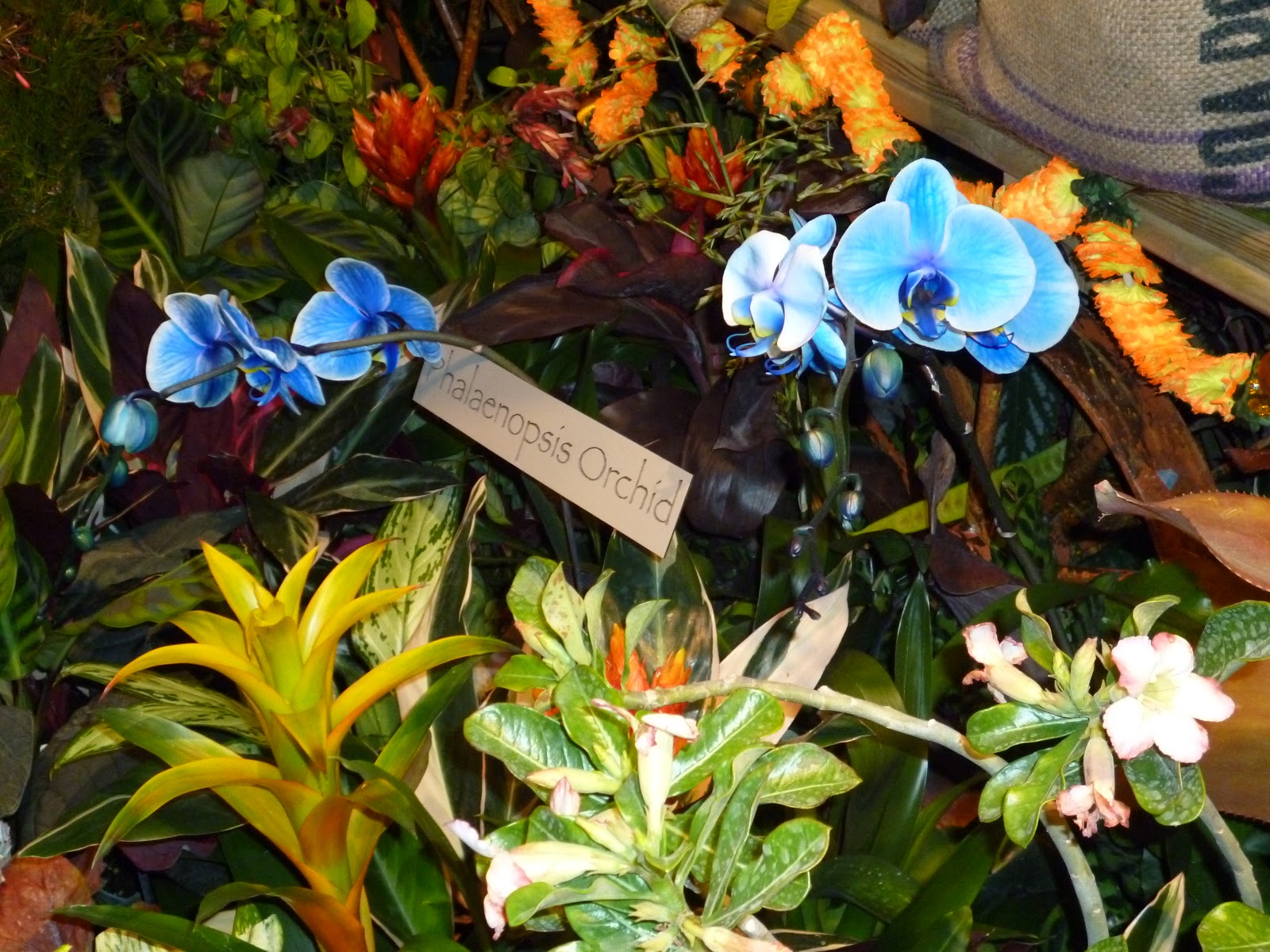
One of my all-time favourite plants and the one I've had the most success in killing is the beautiful Phalaenopsis Orchid also known as the 'Moth Orchid'. These plants bloom in a variety of colours from white through to dark reds and purples and can be solid in colour or spotted like the picture above.


And something I've never seen before was this incredible blue Phalaenopsis.


And below a mass of hot-pink hydrangea is surrounded by clivea which will bloom in bight orange, and delicate pale pink hellebores.


As you wander through the tent which is divided into a number of 'garden rooms' you come across the calming central fountain which is carved in white marble and surrounded by a mass of flowers such as tulips and begonias. I'm not sure what the blue flower is (can anyone help?) but it looks like a Cenatura or 'bachelor's button.


Passing through an arched wall, again topped with a garden of trailing flowers you enter what would be described as the spice market!                               


Bags of colourful spics compete with the flowers and add splashes of yellow, red and orange to the colour palate!


And just near the exit an array of pinks include azaleas surround a pink and green bormeliad. While below... red,cream and green striped Negoregelia bromeliads are surrounded by a mass of orange blooms of begonias, cliveas and gerberas.


And finally....a small thought....a message of peace and hope printed on the large window display pictured above with the peacock as it's centerpiece.


Time is a shifting perception.
Ancient symbol of immortality, the peacock,
preens amid the primrose, allegory of youth.
But look again. Those resplendent tail "feathers"
are concocted of palm, timeless sign of peace.
May there BE.


Tuesday, 26 February 2013

Herbalicious....

Even if your thumbs are more brown than green and you live in a city apartment with a balcony the size of a cupboard, you can still have the pleasure of growing your own herbs without too much fuss.

Herbs are really quite easy to grow and not only look great, they're useful in the kitchen as well. Herbs can also be planted as a green backdrop to flowering plants in a container or garden bed which makes them not only practical but beautiful as well.

One of the most useful and easiest to grow would have to be Parsley (Petroselinum crispum). It's bright green leaves may be added to a multitude of dishes and the stems are often used to flavour soups and casseroles. 

    
Pictured left is the common 'Curley-leafed Parsley'.


Another often used variety is the 'Italian' or 'Continental leaf' parsley which has a flatter leaf and more distinct taste making it very useful for cooking.


One of my favourite herbs to grow has the most amazing smell....it reminds of of summer. Basil or Ocimum basilicum, must have one of the most recognisable smells of all herbs!


What would Italian cooking be without basil? Basil is actually a part of the 'Mint' family Lamiacece and actually originates in India! Yes...India where it has been cultivated for over 5000 years!! And if you've been fortunate enough to travel through Southeast Asia I'm sure you'll have tasted the widely used 'holy basil' or Ocium tenuiflorum which is widely used in the cuisines of Thailand, Cambodia, Vietnam, Laos and Indonesia. 

Not only useful in cooking, basil has also been used for it's medicinal properties in Ayurveda, the traditional medicinal system in India.

Now, as a 'true blue' Aussie, who could go past a lamb roast??? And what's a lamb roast without two of our favourite herbs?? Mint and Rosemary.

The mint family is divided into 13 to 18 species. (this is not completely clear as there has been some hybridisation among the species and there are many cultivars) Mint is an extremely recognisable aromatic herb which is perennial, which means that it will last through the year and does not need to be replanted every season. Mint grows well in damp to moist soil and will spread through underground runners in the right condition. Ideally it should be grown in a pot or in a contained garden bed on it's own and kept quite moist.

  
Mint was originally used as  a medicinal herb and is still used today to treat stomach upsets. Mint is also thought to stimulate the mind!!! In ancient times it was strewn across the floor to mask the smells and odours of the day...as people walked over the mint they crushed the leaves, releasing its pleasant scent. Today it is the most predominant flavouring used in toothpaste due to it's refreshing and reviving taste.

Rosemary (Rosmarinus officianalis) is a woody perennial herb with fragrant, evergreen needle-like leaves. Funnily enough it is also a member of the 'Mint' family 'Lamiaceae' as are many other herbs. Rosemary is native to the Mediterranean region and is very drought tolerant and hardy in exposed windy and salty conditions. The forms of rosemary range from bushy and upright, to trailing ground-cover.


Being such a hardy but attractive herb, rosemary is used in many garden situations and is useful as a hedge. Depending on the species it will flower with white, pink mauve or blue blooms. Rosemary is traditionally used as a flavouring for lamb and casseroles; small branches of rosemary will impart flavour to food when it's burnt in a bbq or grill. 

Medicinally rosemary was used as a tonic to aid memory loss and is still used in Australia today, small sprigs of rosemary pinned to the lapel to honour and 'remember' those that fell in the great wars. Rosemary grows wild on the Gallipoli Peninsular.

Plant rosemary in a pot of well drained soil and water sparingly. Pinch it back regularly to encourage bushy new growth.


Other herbs that will grow well in containers and pots are Thyme (Thymus vulgaris), Oregano (Oreganum vulgare) and Tarragon (Artemisia dracunculuc) all of which will grow happily together in the same pot as they have similar growing conditions and requirements.


Even if your not the world's best gardener or an award winning chef, herbs are easy to grow and will bring colour and fragrance to a garden, balcony, terrace or even into your home.

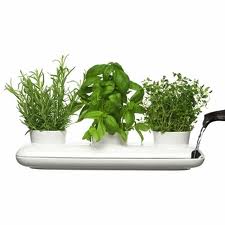
Get creative and pot a a miniature herb 'garden' such as the pictures above or plant up small individual herbs in smart modern pots as practical and personal gifts for family and friends. A 'herbalicious gift' is the perfect gift for that special someone who has everything!